मानवी जीवनात शिक्षणाचं महत्व फार आहे. शिकणं ही माणसाची उपजत प्रवृत्ती आहे. प्राणी जगतात जगण्याची कला काही उपजत तर काही शिक्षणातून, अनुभवातून साध्य होते. साधं कुत्र्याच्या पिल्लाचं उदाहरण घेतलं तरी असं दिसतं की जन्मतःच त्याचे डोळे उघडलेले नसतात. तरीही ते त्याच्या आईचे स्तन बरोबर शोधून काढतो आणि लुचतो. हे पिल्लू मोठं होत जातं, तसतसं त्याचं प्रशिक्षण सुरु असतं. कुत्र्याची पिल्लं त्याच्या आईबरोबर खेळताना ज्यांनी पाहिली असतील त्यांच्या लक्षात येईल की कुत्री त्या खेळातून पिल्लाला जीवनाचे धडे देत असते. धावायचं कसं? पाठलाग कसा करायचा? हल्ला कसा करायचा? हल्ला चुकवायचा कसा? कुरघोडी कशी करायची आणि वेळ आल्यास जीव बचावून पळून कसं जायचं हे श्वान जीवनात जगण्यासाठी आवश्यक शिक्षण या खेळातून मिळत असतं. या शिक्षणाला पुढे अनुभवाची जोड मिळत जाते. त्यातून गिरवलेले धडे पक्के होत जातात. शिकारी प्राण्यांचं शिक्षण प्रामुख्याने हल्ला कसा करायचा हेच असतं. तर हरणासारखे शिकार होणारे प्राणी संकट येताच तिथून चटकन् पळून जाऊन जीव कसा वाचवायचा याचंच शिक्षण आपल्या पिल्लांना देतात. हरीण काही वाघाशी टक्कर देऊ शकत नाही. म्हणून शक्य तितक्या वेगाने वाघापासून दूर पळून जाण्याची कला शिकणं त्याच्यासाठी महत्वाचं असतं. वाघ गवत खाऊन राहू शकत नाही. त्यामुळे तो जर शिकार करु शकला नाही तर जगू शकणार नाही. म्हणून त्याला शिकार करण्याचं शिक्षण योग्य वयात मिळणं हे त्याच्या हिताचं असतं. ज्याने हित साधलं जाईल असं शिक्षण देणं ही नीती असली पाहिजे. योग्य शिक्षण मिळालं नाही तर काय होतं त्याचं प्रत्यंतर मानवाच्या इतिहासात वारंवार आलं आहे. प्राणी जगतातलं जगणं एका अर्थाने सोपं नसलं तरी साधं, सरळ आहे. पण मानवी जगणं फार, फार गुंतागुंतीचं आहे. मानवी जगण्याचा परिघ प्रचंड व्यापक आहे. शेतकऱ्यांची परिस्थिती आज पाहिली तर लाखो शेतकऱ्यांनी आजवर आत्महत्या केल्या. दिवसे न् दिवस शेतकरी नागवला जातो आहे. पूर्वी जगण्यासाठी मातीतून धान्य पिकवण्याची कला कुणब्याकडे असली तर पुरेशी होती. त्या बळावर तो स्वतःही जगत होता आणि सर्व समाजालाही जगवत होता. पण आज नुसतं पिकवता येण्याची कला पुरेशी नाही. विकण्याची कलाही शेतकऱ्याला अवगत करावी लागेल. विकण्याची कलाही पुरेशी नाही तर वर जे सत्तेत बसले आहे त्यांना वेसण घालण्याची वा तिथून हटवण्याची कलाही शेतकऱ्याला आता शिकावी लागेल. आपल्या हक्कासाठी लढायला शिकावं लागेल.विविधांगी शिक्षण शहाजी महाराजांनी शिवरायांना दिलं. आपला पुत्र विश्ववंद्य व्हावा असं स्वप्न पाहणारा शहाजी महाराजांसारखा दुसरा पिता मानवाच्या इतिहासात दुसरा कोणी नाही. आपल्या पुत्राला जी इतिहासदत्त जबाबदारी पेलायची होती तिला आवश्यक आणि हिताचं शिक्षण शहाजी महाराजांनी आपल्या पुत्राला, शिवरायांना दिलं म्हणून मग पुढे नवा इतिहास घडला. युगपुरुष म्हणून शिवराय मानवी इतिहासात अजरामर झाले. शिक्षण इतकं महत्वाचं, प्रभावी आणि माणसाच्या आणि समाजाच्या भविष्यावर दूरगामी परिणाम करणारं असतं.मागच्या हजारो पिढ्या जशा गुलामीत जगल्या तशाच पुढच्या पिढ्यांनाही गुलामीत जगावं लागेल. हे जाणलं म्हणून महात्मा जोतीराव फुले यांनी शिक्षणापासून कामाला सुरुवात केली. म्हणून राजर्षी शाहू महाराज आणि महाराजा सयाजीराव गायकवाड यांनी शिक्षणप्रसारासाठी प्रयत्नांची शर्थ केली. म्हणून बाबासाहेब आंबेडकरांनी आपल्या अनुमायांना, “शिका, संघटित व्हा आणि संघर्ष करा” असा संदेश दिला. म्हणून कर्मवीर भाऊराव पाटलांनी माझ्या डोक्यावर जितके केस आहेत तितकी बहुजनांची मुलं शिकवून तयार करीन अशी प्रतिज्ञा केली. म्हणून पंजाबराव देशमुख, यशवंतराव चव्हाण यासारख्या नेत्यांनी शिक्षणप्रसाराला अग्रक्रम दिला. समाजाचं हित साधायचं असेल तर त्याला तसं शिक्षण देण्याची नीती स्विकारावी लागेल असं तुकोबारायांनी चारशे वर्षांपूर्वी सांगितलं. आजही ते तितकंच महत्त्वाचं आणि उपयुक्त आहे आणि उद्याही ते तितकंच महत्वाचं आणि उपयुक्त राहिल. प्रत्येक समाजहितैषीसाठी ते दिशादर्शक होतं, आहे आणि असेल. तुकोबाराय म्हणतात,

*शिकवूनि हित । सोयी लावावे हे नीत ।।*

हिताचं ते शिकवून नीट मार्गाला लावणं यालाच नीती म्हणतात.(या नीतीचा) त्याग करु नये. नेमकं याच्या उलट काम इथं मनुस्मृती प्रणित चातुर्वर्ण व्यवस्थेने केलं. शिक्षणाच्या अंतर्भूत या ज्या क्रांतीकारक क्षमता आहेत त्या गर्भातच नष्ट करुन टाकण्यासाठी वर्णव्यवस्थेने सर्व स्त्रीया आणि शूद्रातीशूद्रांवर ज्ञानबंदी लादली आणि त्यांच्या हजारो पिढ्या अज्ञान अंधःकारात खितपत पडल्या गुलाम झाल्या. या लोकांना शिकूच द्यायचं नाही म्हणजे ते कधीही स्वतंत्र होऊ शकणार नाहीत असा प्रयत्न वर्णव्यवस्थेच्या लाभार्थ्यांनी शेवटपर्यंत केला.चुकीचा उपदेश करण्यात काही जण तरबेज असतात,चुकीचा रस्ता दाखवून एखाद्याचं वाट लावण्यात काही खूप हुशार असतात, अशा गोष्टीत त्यांना खूप आनंद होतो. अशा लोकांचा तुकोबाराय धिक्कार करतात.लोकांना त्यांचं भलं कशात आहे हे सांगावं, त्यांना सोयीला लावावं हेच हिताच आणि सदाचार आहे. एखाद्याला सोयीला लावता आलं नाही तरी चालेल, तर त्याची हरकत नाही. चुकीचा सल्ला देऊन त्याची वाट लावू नये. थोडक्यात काय तर एखादं चांगलं नाही करता आलं तरी चालेल पण वाईट तरी करू नका.
HOW TO STUDY WHEN EXAMINATIONS ARE KNOCKING AT THE DOOR


How to study when examinations are knocking at the door**LAST MONTH STUDY PLAN*

*In the  student’s diary,  of our Hasti school,   there use to be a  smart time table and detailed subject wise allotment of  time for study* . Our school use to distribute the *smart study time table to the students from class I to XII for their study at home*  *{with the detail study plan day wise and an hour wise inclusive of special time table for Sundays* }.  Students too try to do their best and appear for each exam.conducted and orgnised by school for the improvement in their performance.

*It’s a fact that sincerity comes to its best for For  our students When the exams get near* , *it is crucial  for our students to put their  efforts in full throttle* and *prepare for the final examination  in the last months that remain*.

 *It is the time to get rid of distractions, reduce the use of social media, decrease your T.V. time, and *study with laser-sharp focus to perform excellently* , * no matter how much preparation you have done with your daily study earlier*.

*The amount of study students  do in the last month towards exams makes a tremendous difference in your performance and confidence on the academic front*.

The educators of our school take lot of pains and leave no stone unturned  to prepare students  to excel in the examinations ( for school  exam. as well as for public examinations)*

However students need to focus on their studies  at home,  following the guidelines given by school from time to time . Parents get worried as well when  examinations approach. The parents here need to support their wards and give their  time to comfort them at these hours of stress. *I wish parents to look in to the following points  and see that their wards follow the practical advice and or valuable pointers given hereunder*

Dear students;

  1. *Make  a study plan  and follow it honestly*
  2.  Since you will be sitting for multiple exams, it makes sense for you to *give structure to your study routines* and allocate *ample time to different subjects and topics to cover*. 
  3. *Break down the syllabus into small chunks* that you can easily cover. While making your study plan, *make sure to pair the challenging subjects between the topics that are a breeze for you*. This will give you a breather and keep your motivation at its peak
  4. As you progress through your syllabus, *create compact & to-the-point revision notes side by side* so that it is easy for you to get second or third revisions when the exam is near.
  5. *Do Mock Tests*  To test your proficiency and know the areas to work on, sit for mock tests. You can *try solving previous years’ papers so that you have a fair idea of the kind of questions that appear*. This way, you will be able to work on your speed as well.
  6. *Say ‘No’ to Cramming*  *Cram and your chances of forgetting what you have learned are high*. Understand the topics and you will remember concepts for not just the exams but life.
  7. *Do not touch new topics right before exams*, plan to cover them beforehand instead or you will forget the topics you prepared well.
  8. Clear Your Doubts *Many questions will pop up in your mind while you prepare and you shall feel free to ask them and get them sorted from your educators*. Do not be afraid to ask or hesitant that it’s last minute. Your teachers would love to help you with revisions and doubts.
  9. *Revise Within 24 Hours* To remember well and commit what you learn to your long-term memory, *revise the topics within 24 hours*. Studies indicate that if you don’t do this, your mind will have trouble remembering 80% of what you have learned. This simple trick will help you memorize more and comprehend well.
  10. *Alternate Between Different Subjects*  *The subjects you are supposed to study deal with the various faculties of your mind* such as *memory, problem-solving, interpretations, and more*.  *Alternating between them can help you relax your mind while you are on a continuous study spree*. Also, remember the *best way of multitasking is single-tasking*. Take breaks between study sessions as well.
  11. *Avoid Distractions* Since it’s exam time, it makes sense to prioritize studying* and *postpone making plans with friends to catch up, being active on social media, and checking your buzzing phone*. Tell people that you will be occupied with your studies and will have space for other things later on. *Concentrate on the information you learn and give your mind some rest from time to time by meditating and spending time in nature*.
  12. *Do Not Panic*  *Exam time can be stressful as there is so much to cover and so little time to do* it but *panic is not productive. It is only a distraction and doesn’t help but cause harm by wasting time*. So *stride ahead confidently that you will give your best and cover the topics well enough* to perform excellently in your academics.
  13. *Sleep At Night*  *When you compromise on your sleep for study, you are decreasing your chances of committing the concepts you learn to your long-term memory*. Proper sleep will give your mind and body the adequate rest they need and will elevate your energy levels.
  14. *Do Group Studies if it suits you *    *The best way to learn something is to teach it*. Study in a group, discuss concepts, clear your doubts, help your friends with their questions, and prepare in an interactive way that will keep your

*Find a plan for the last month study*

*Week 1: Subject-wise Review*

*Day 1-2: Prioritize Weaker Subjects*

Identify the subjects you find most challenging and allocate the initial days to review key concepts and practice problems in these areas.

*Day 3-4: Subject-wise Revision*

Dedicate specific days to each subject, revisiting important topics and going through your notes. Focus on understanding rather than memorizing.

*Day 5-7: Solve Sample Papers*

Start solving sample papers to get accustomed to the exam pattern. Time yourself to simulate exam conditions and identify areas that need improvement.

*Week 2: Intensive Practice*

*Day 8-10: Mock Tests*

Take full-length mock tests for each subject. Analyze your performance, pinpointing weak areas. Devote extra time to understanding and rectifying mistakes.

*Day 11-14: Revision and Clarifications*

Review your notes and textbooks for any doubts. Reach out to teachers or peers for clarifications. Create concise notes for last-minute revision.

*Week 3: Strategy Refinement*

*Day 15-17: Time Management*

*Fine-tune your time management skills. Focus on allocating specific time slots for each section during the exam. Practice writing essays and long answers within the stipulated time*.

*Day 18-20: Revision of Formulas and Diagrams*

Compile and revise important formulas, equations, and diagrams. Create visual aids to facilitate quick recall during the exam.

*Day 21-22: Stress Management*

*Incorporate short breaks and relaxation techniques into your study routine. Adequate rest and stress management are crucial for optimal performance*.

*Week 4: Final Polish*

Day 23-25: Subject-wise Quick Revision

Go through each subject for a final quick revision. Pay special attention to the topics that you’ve found challenging in the past.

*Day 26-28: Previous Year Question Papers*

Solve previous year question papers to familiarize yourself with the exam pattern and types of questions. Identify recurring themes and focus on mastering them.

*Day 29-30: Last-minute Tips and Relaxation*

Review your notes, but avoid starting anything new. Focus on staying calm and confident. Ensure that you get a good night’s sleep before the exam day.

Remember, the key to success lies not just in the number of hours you put in, but in the quality of your preparation. Stay focused, maintain a positive mindset, and believe in your abilities. Best of luck for your board exams!

*Finally  Having a preparation strategy in place goes a long way and ensures all the topics get covered and revised. It keeps stress and panic at bay and helps you perform I am sure  that you will excel in your examinations . Wish you all the best for examination.


खूप खोल आणि अतिशय सूक्ष्म सत्य मी व्यक्त केलं आहे.
हे फक्त शब्द नाहीत—ही कुंडली, ग्रह आणि घरातील ऊर्जेचं तंतोतंत विज्ञान आहे.
आपण ज्या घरात राहतो, तिथल्या नात्यांवर आपल्या ग्रहांची ऊर्जा कशी चालते? तुम्ही नीट विचार करा.
जन्म कुंडली म्हणजे फक्त ग्रह नव्हेत—
जन्म कुंडली म्हणजे आपले विचार, भावना, वर्तन आणि नात्यांचा आरसा.
घरातील वातावरण, बोलण्याची पद्धत, लक्ष, प्रेम, सेवा—
या गोष्टी ग्रहांना सक्रिय (Active) करतात किंवा निष्क्रिय (Disable).
जन्म कुंडलीतील ग्रह आपण ज्या घरात राहतो त्या घरात आपण कसे सक्रिय करतो आणि निष्क्रिय करतो तुम्ही नीट वाचा.
जन्म कुंडलितील सूर्य – प्रतिष्ठा, आत्मविश्वास, नेतृत्व
जर घरी तुम्ही बोलत नाही, ऐकत नाही, नात्यांमध्ये आदर देतं नाही
👉 सूर्य निष्क्रिय (Deactivate)
👉 घरात सतत अहं, वाद किंवा दुर्लक्ष
जन्म कुंडलितील चंद्र – मन, भावना, शांती
जर तुम्ही घरात बसत नाही, बोलत नाही, भावना शेअर करत नाही—
👉 चंद्र कमजोर
👉 मन चंचल, anxiety, बाहेर कोणाच्या बोलण्यावर जास्त विश्वास
जन्म कुंडलितील मंगळ – साहस, रक्षण, ऊर्जा
घरासाठी काही करू वाटत नाही?
पालकांसाठी किंवा कुटुंबातील माणसांसाठी काही आणावं असं वाटत नाही?
👉 मंगळ कमजोर
👉 ऊर्जा बाहेर वाया जाते, घरात शून्य
जन्म कुंडलितील बुध – संवाद, समजूत, संवादाची गोडी
घरात संवाद नाही
मनातलं शेअर नाही
हर एक वाक्य कठोर किंवा तुटक कुटुंबातल्या माणसांशी
👉 बुध निष्क्रिय
👉 गैरसमज, तणाव, शांतता संपते
जन्म कुंडलितील गुरु – आशीर्वाद, घराची वाढ, कुटुंबाची उन्नती, माहिती, संस्कार
आई-वडिलांसाठी आदर नाही
त्यांच्या संस्कारांना “जुने, गावंढळ” म्हणणं
👉 गुरु रुसतो
👉 घरात लक्ष्मी थांबते, समृद्धी अडते
जन्म कुंडलितील शुक्र – प्रेम, आनंद, सौंदर्य
कुटुंबातून आनंद नाही,
हसू नाही
गिफ्ट नाही
भावना नाही
👉 शुक्र पडतो
👉 प्रेमाची ऊर्जा घरातून निघून जाते
जन्म कुंडलितील शनि – कर्तव्य, जबाबदारी, सेवा
घरात जबाबदारी नाही
सेवा नाही
त्यामुळे शनीचा आशीर्वाद मिळत नाही
👉 शनि अडथळे वाढवतो
आणि हे झालं की कुंडलीत फक्त एकच ग्रह उरतो — केतू!
केतू म्हणजे:
डिटॅचमेंट
वेगळेपणा
घरापासून अंतर ,घरातल्या लोकांपासून अंतर,वरच्यावर बोलणं
भावना तुटणे
मन दुसरीकडे जोडणे
जन्म कुंडलितील केतु घरात सक्रिय = आपण आपल्या लोकांपासून तुटतो
आणि—
जन्म कुंडलितील
राहू बाहेर सक्रिय = आपण बाहेरच्या जगाशी अटॅच होतो
(कोणते लोक, कोणत्या नात्यांशी, कोणत्या गोष्टींशी, कोणत्या अपेक्षांशी…)
मग ७ ग्रह घरातून का निष्क्रिय होतायत?
कारण:
घरी प्रेम नाही
लक्ष नाही
सेवा नाही
संस्कारांचा आदर नाही
कृतज्ञता नाही
संवाद नाही
विश्वास सहवास नाही
जिथे ऊर्जा नाही, तिथे ग्रह जिवंत राहू शकत नाहीत.
आणि मग तुम्ही बाहेरच्या व्यक्तीसाठी ७ ग्रह Active करतात!
हो!
ज्या व्यक्तीकडे तुम्ही:
लक्ष देता
वेळ देता
प्रेम दाखवता काळजी दाखवता
इच्छा जागवता
संवाद करता
त्यांचं बोलणं ऐकता
👉 त्या व्यक्तीसोबत सगळे ७ ग्रह सक्रिय होतात
👉 घरात मात्र ते ग्रह मृत (inactive)
आणि मग घरात आनंद का नाही मिळत?
ग्रहाने तुम्हाला दाखवलंच ना—
ऊर्जा जिथे देता, तिथूनच परत मिळते.
शेवटचं आणि सगळ्यात महत्वाचं:
जन्मकुंडली घरात काम का करत नाही?
कारण तुम्ही घरात काम करत नाही. तुम्ही घरात एखाद्या पुतळ्यासारखे राहता,निर्जीव,कामा पुरते.
ग्रह एखाद्या मशीनसारखे नाहीत—
ते आपल्या वागणुकीनुसार जीवंत होतात.
जिथे:
प्रेम
सेवा
संवाद
आदर
विश्वास
करुणा
कृतज्ञता
या ऊर्जांचा प्रवाह असेल—
👉 तिथे ७ ग्रह बलवान
👉 तिथे राहू-केतू शांत
👉 तिथे घर सुखाचं
मग आजच तुमची वागणूक बदलून बघा आणि जरा जगून बघा! घरात, तुमच्या माणसात, तुमच्या कुटुंबात केतू ग्रह ऍक्टिव्ह करू नका राहु ग्रह ऍक्टिव्ह करा!
आनंद घ्या जीवनाचा प्रत्येक क्षणाला

INCREDIBLE BHARAT


We know only three branches when we were growing up, Science, Arts, Commerce.
In 1978, Engineering colleges had five branches: Civil, Mechanical, Electrical, Chemical and Electronics.
But do you know our Indian schools were teaching 50-72 different vidyas, before 1858?
The system of Indian schools was destroyed by British visionaries.
The first school in England opened in 1811. At that time India had 732000 Indian schools!
Find out how our schools got closed. How did Indian school learning end?
First know which disciplines were taught in indian culture !!
Most Indian schools taught the following subjects:
01 Agni Vidya (Metallurgy)
02 Vayu Vidya (Wind)
03 Jal Vidya (Water)
04 Antriksh Vidya (Space Science)
05 Prithvi Vidya (Environment)
06 Surya Vidya (Solar Study)
07 Chandra and Lok Vidya (Lunar Study)
08 Megh Vidya (Weather Forecast)
09 Dhaatu Urja Vidya (Battery energy)
10 Din aur Raat Vidya.
12 Srishti Vidya (Space Research)
13 Khagol Vigyan (Astronomy)
14 Bhugol Vidya (Geography)
15 Kaal Vidya (Time studies)
16 Bhoogarbh Vidya (Geology and Mining)
17 Gemstones and Metals (Gems and Metals)
18 Aakarshan Vidya (Gravity)
19 Prakash Vidya (Energy)
20 Sanchaar Vidya (Communication)
21 Vimaan Vidya (Plane)
22 Jalayan Vidya (Water Vessels)
23 Agneya Astra Vidya (Arms and Ammunition)
24 Jeevavigyaan Vidya (Biology, Zoology, Botany)
25 Yagna Vidya (Material Sic)
This is the talk of scientific education.
Now let’s talk about professional and technical disciplines that were covered !!
26 Vyapaar Vidya (Commerce)
27 Krishi Vidya (Agriculture)
28 Pashu Paalan Vidya (Animal Husbandry)
29 Pakshi Paalan (Bird Keeping)
30 Yaan Vidya (Mechanics)
32 Vehicle Designing
33 Ratankar (Gems and Jewellery Designing)
36 Kumhaar vidya (Pottery)
37 Laghu (Metallurgy & Blacksmith)
38 Takkas
39 Rang Vidya (Dyeing)
40 Khatwakar
41 Rajjukar (Logistics)
42 Vaastukaar Vidya (Architecture)
43 Khaana Banane ki Vidya (Cooking)
44 Vaahan Vidya (Driving)
45 Waterways Management
46 Indicators (Data Entry)
47 Gaushala Manager (Animal Husbandry)
48 Baagvaani (Horticulture)
49 Vann Vidya (Forestry)
50 Sahyogee (Covering Paramedics)
All this education was taught in school, but with time, when school disappeared, this knowledge was made to disappear by the British !!
It started with Macaulay.
Today, the future of the youth of our country is being destroyed by the Macaulay method.
How did school culture end in India?
The introduction of Convent education ruined schools. The Indian Education Act was formed in 1835 (revised in 1858). It was drafted by ‘Lord Macaulay’.
Macaulay conducted a survey of education system here while many Britishers had given their reports about India’s education system. One of the British officer was G.W. Luther and the other was Thomas Munro!
Both of them had surveyed different areas at different times. Luther, who surveyed North India (Uttar Bharat), wrote that there is 97 % literacy here and Munro, who surveyed South India (Dakshin Bharat), wrote that here there is 100% literacy.
Macaulay had clearly said that if India (Bharat) is to be enslaved forever, its “indigenous and cultural education system′′ must be completely demolished and replaced with ′′English education system′′ and only then will Indians be physically Indians, but mentally become English. When they leave the convent schools or English universities, they will work in the interest of British.
Macaulay used an idiom – ′′Just as a farm is thoroughly ploughed before a crop is planted, so must it be ploughed and brought in the English education system.′′ That’s why he first declared schools illegal. Then he declared Sanskrit illegal and set the schools on fire, beat the teachers in it and put them in jail.
Till 1850 there were ‘7 lakh 32 thousand’ schools and 7,50,000 villages in India. Meaning almost every village had a school and all these schools used to be ‘Higher Learning Institutes’ in today’s language. 18 subjects were taught in all of them and the people used to run these together, not the king!
Education was imparted free.
These Schools were abolished and English education was legalized and the first convent school opened in Calcutta.
That time it was called ‘free school’. Under this law, Calcutta University, Bombay University and Madras University were created. These three slavery-era universities are still in the country!
Macaulay had written a letter to his father. It is a very famous letter, in it he writes: “These convent schools will bring out children who look like Indians but are English by brain and they don’t know anything about their country. They won’t know anything about their culture, they won’t have any idea about their traditions, they will not know their idioms, when such children are there in this country, even if the British go away, English will not leave this country.′′
The truth of the letter written at that time is clearly visible in our country even today. See the misery created by this Act. We feel inferior of ourselves who are ashamed to speak our own language and recognise our own culture.
A society that is cut off from its mother tongue never flourishes and this was Macaulay’s strategy!
Today’s youth here knows more about Europe than India.
Considers Indian culture not so cool, but imitates Western country.
What a pity!
It’s high time we all awaken and reclaim our great culture and heritage.
🙏🙏🙏🙏🙏
ncredible Bharat

THE MISLABELED BOX PRINCIPLE


THE “MISLABELED BOX PRINCIPLE”
How FedEx Accidentally Created One of the Most Trusted Shipping Systems in the World
In the early days of FedEx, long before tracking numbers, apps, and overnight guarantees, everything depended on a simple system:
Labels.
One afternoon, a package arrived at a Memphis sorting facility with a problem:
The label was wrong.
Wrong name.
Wrong address.
Wrong routing code.
A total disaster in the shipping world.
Supervisors insisted it wasn’t their fault…
the sender mislabeled it.
The mistake happened before FedEx ever touched it.
But Fred Smith, FedEx’s founder, didn’t care.
He held up the box in a team meeting and asked:
“When a customer hands us a package…
whose problem is it?”
Silence.
Then he answered his own question:
“Ours. Always ours.”
That one belief reshaped FedEx forever.
They redesigned the sorting process.
They standardized labeling instructions.
They built redundancy into every checkpoint.
They trained employees to intercept errors before they traveled downstream.
FedEx didn’t grow because they shipped faster.
FedEx grew because they took responsibility for problems they didn’t even cause.
The mislabeled box became a symbol inside the company:
Not of error…
but of ownership.
💡 THE MARKETING LESSON
Customers don’t judge you by what goes wrong.
They judge you by what you take ownership of.
*Most businesses INSTITUTIONSlose trust because they say:
“That’s not our fault.”
“(That’s the customer’s mistake.”
“That happened before it got to us.”
FedEx did the opposite …
and built a billion-dollar reputation.
That’s why:

  • Apple replaces devices even when the issue is unclear
  • Ritz-Carlton empowers employees to fix any problem on the spot
  • Amazon refunds first, investigates second
  • Zappos pays for return shipping, no questions asked
    Responsibility creates loyalty.
    Loyalty creates growth.
    🧠 THE NERDY TAKEAWAY
    The “Mislabeled Box Principle” teaches this:
    The fastest way to build trust is to own problems you didn’t create.
    Customers don’t want perfection.
    They want partnership.
    When you take responsibility for the entire journey
    even the parts you didn’t break …
    you become unforgettable.
    Because in a world full of companies pointing fingers,
    the one that raises its hand…
    wins

The Pros and Cons of Homework


The value of homework is one of education’s most heated debates—and one of its most misunderstood.

For some, homework reinforces learning while building study habits. For others, it’s unnecessary busywork that fuels stress and disengagement.

Decades of research, however, suggest that the truth lies somewhere beyond these binary distinctions: Homework has increasing value as students climb through the grade levels, and that’s especially true in high school, once time-management skills are in place. For younger students, the gains, when they can be spotted at all, are more nuanced—but at any grade level, from elementary to high school, poorly designed tasks or rigid homework policies can create more problems than they solve.

“Homework is a practice full of contradictions, where positive and negative effects coincide,” researchers explain in a 2017 study. Purposeful, well-designed assignments can extend classroom lessons while helping students manage their own learning. Daily at-home reading, research shows, can deliver meaningful, long-lasting benefits to literacy.

Balance and teacher discretion is crucial: A growing body of research reveals that excessive homework displaces activities that support healthy development, from sleep and family time to hobbies and friendships, and can significantly increase unhealthy stress levels—all of which can take a toll on student engagement and mental health. Finally, not all students have equal access to the tools needed to complete assignments, especially as more schoolwork shifts online.

Here are six charts that shed light on the ways that homework helps or hinders, bringing a research lens to an admittedly tough conversation.

01 A Significant Boost for Older Students, a Foundation for Younger Ones Less is more for novice learners—and well-crafted assignments are key.

When people make a no-homework-ever argument, it’s often based on a binary interpretation of the research: Homework is bad in the early grades and better as kids get older—but it’s generally of negligible benefit across the grade bands.

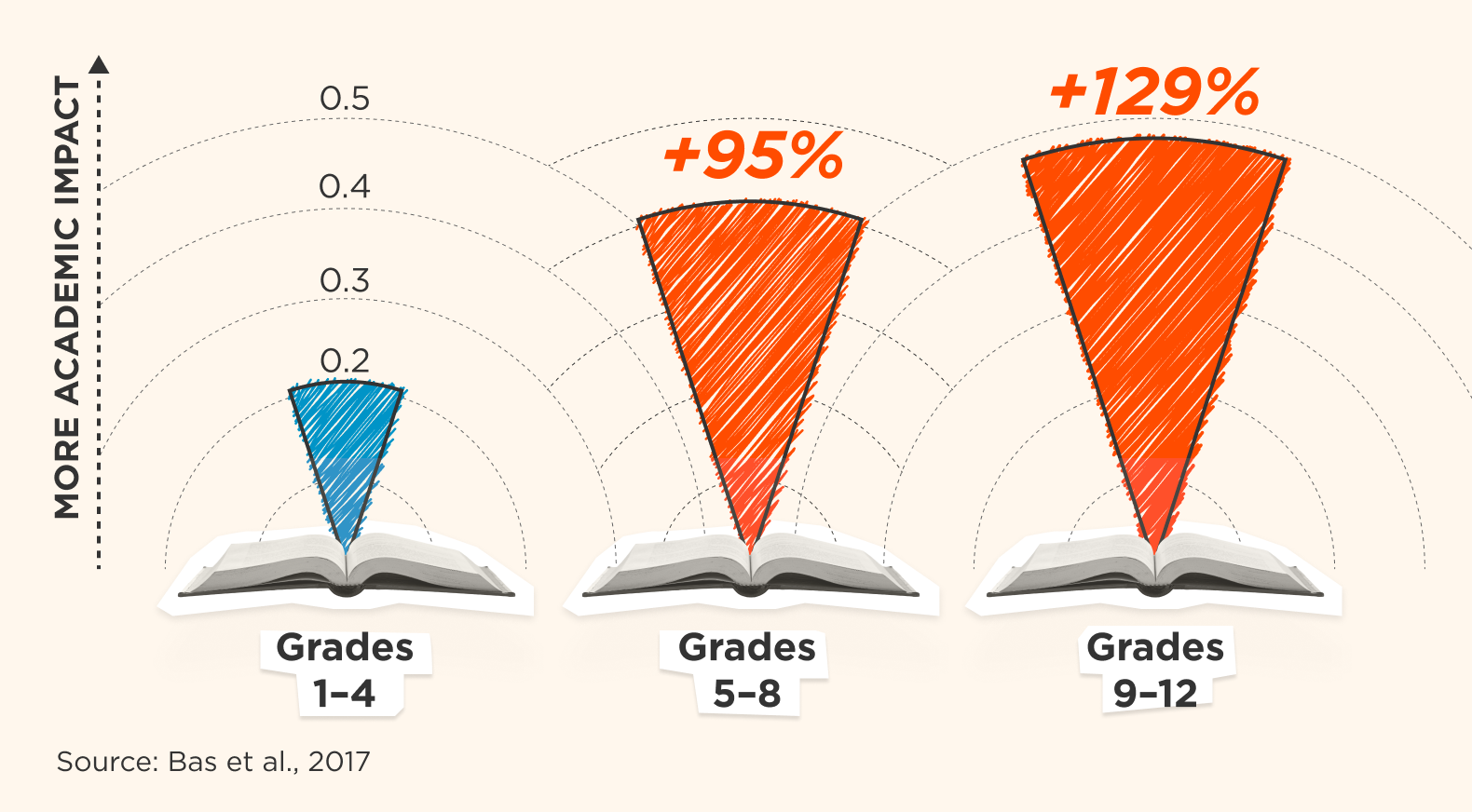
The research reveals a more complex landscape. In a 2017 meta-analysis, researchers found that while the academic impact of homework for students in grades 1–4 is indeed limited—with a small effect size of 0.21—it grows steadily through upper elementary school and into high school, rising by 95 percent for grades 5–8 and 129 percent for grades 9–12, respectively. As students mature and develop the ability to “prepare more elegant and qualified homework as their skills such as problem-solving, critical thinking, cooperative learning, attention, and concentration improve,” the academic value of homework begins to take shape, the researchers say.

That doesn’t mean that all homework is high value in the later grades or pointless in the early grades—but it does warrant careful scrutiny of homework assignments. A 2023 study, for example, found that for preschool students, there were “positive links between time spent playing at home to self-regulation and, indirectly, their early prereading and math skills a year later.” A 2025 study of fourth-grade students, meanwhile, concluded that cortisol levels—a biophysical measure of stress—more than tripled when recess was cut short. For younger kids and those just starting school, then, play may do more to build both academic skills and emotional regulation than nightly worksheets.

As students reach upper elementary and middle school, the academic impact of homework becomes increasingly clear. Older students are expected to “use different resources like the internet, library, reference books, etc.” to extend their learning outside of the classroom, researchers explain in a 2017 study, helping to prepare them for college-level and professional work. While the importance of other activities and needs like sports, hobbies, and spending time with family must be accounted for, take-home work at this age also allows teachers to fill the gaps of limited classroom time: A lesson on The Handmaid’s Tale or the structure of DNA, for example, often requires students to read material at home and come to class prepared for a deeper discussion.

02 For Young Learners, Don’t Underestimate Context When it comes to homework, reading and writing practice delivers better results than math drills.

Stipulated, then: The no-homework argument for the youngest learners makes sense, on the whole. But a 2022 study reveals an interesting wrinkle in that assertion, as well.

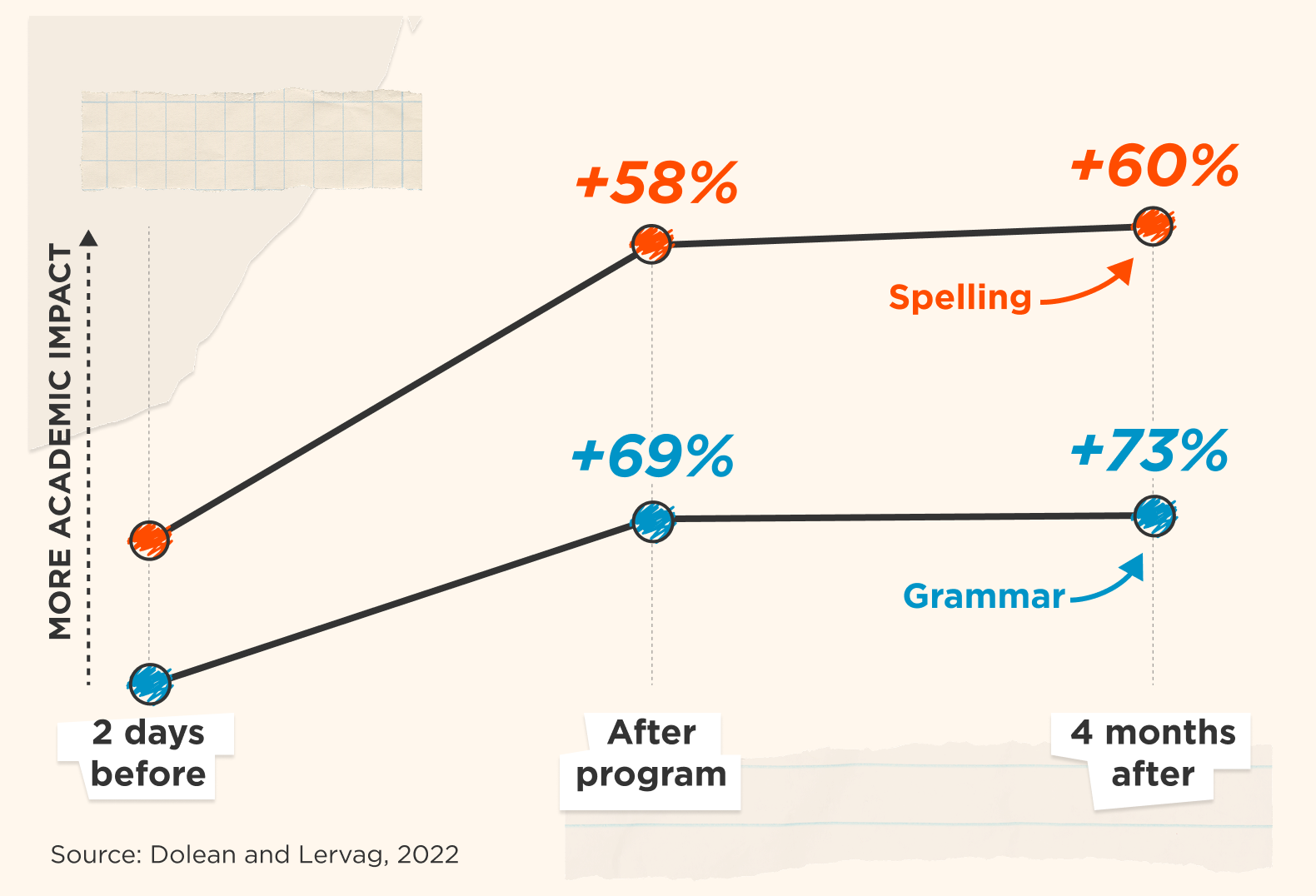
Researchers compared the math and writing homework of 440 second graders and found that students who practiced their literacy skills at home had major gains in grammar and spelling—improvements that persisted four months later. By contrast, extra math homework did little to improve outcomes beyond what students had already achieved in class.

Why was math homework less effective? Too often, it was rote work that repeated the same problems from class, the researchers say. Writing homework, on the other hand, “required students to practice the same type of problems in a different context,” they observe. For example, students may grasp that they’retheir, and there have different meanings during class, but it takes sustained practice outside of class to fluently use the words across a variety of sentences.

In early literacy in particular, the researchers assert, “some skills (such as writing skills) take time and extensive practice to be mastered, and the opportunities for practice provided by a moderate amount of homework can be beneficial to elementary students.”

03The Difference High-Quality Homework Makes Homework that extends classroom thinking improves learning and boosts engagement and study habits, too.

It’s not just about volume: Mandatory or reflexive homework policies, often created at the school or district level, tend to produce a lot of busywork and can waste students’ time. By middle school, low-quality homework of this kind begins to take a toll on student motivation, the research reveals, but when it’s thoughtful and well-designed—and perhaps a little less frequent—take-home work can deliver surprising outcomes.

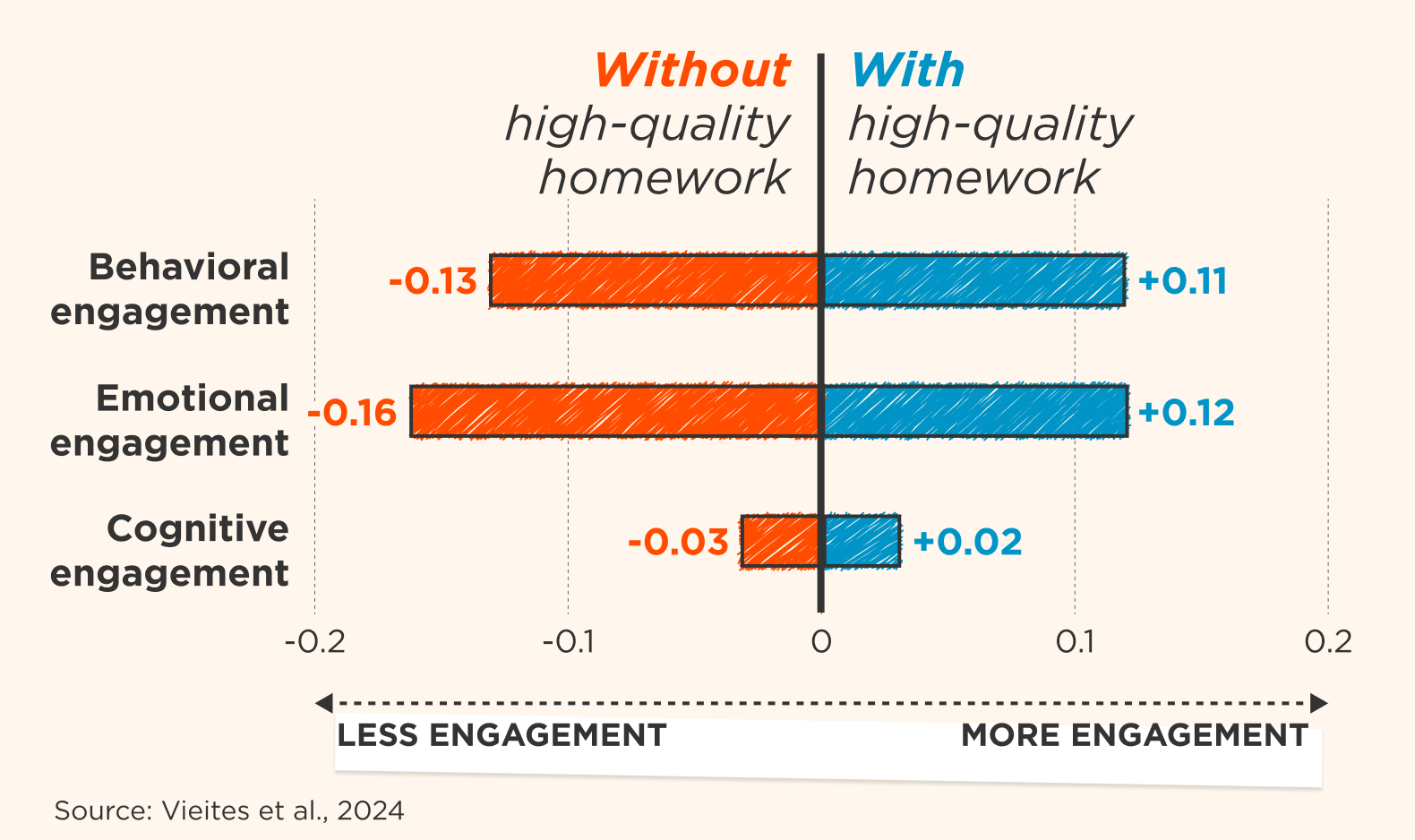
In a 2024 study of nearly 1,000 fifth- and sixth-grade students, researchers found that high-quality homework that asked students to extend their thinking, rather than repeat what was covered in class, led to better emotional and behavioral engagement compared with rote homework tasks. In the study, teachers assigned homework that was “more elaborate” and “worthwhile” for students to complete—preparing a mini-lesson on a topic to present in class, for example, or researching and then debating a public issue—while conveying the “usefulness, interest, importance, and/or applicability of homework.” Compared with their peers in a business-as-usual classroom, whose engagement levels dropped as the year progressed, students who experienced regular, high-quality homework “showed positive emotions, were happier in school and were more interested in the classroom, paid more attention in class, and were more attentive to school rules,” the researchers found.

Thoughtfully designed homework activities can deliver an academic boost, too, without imposing a lot of new grading work on teachers. In a 2024 study, researchers asked university students to grade their own homework, comparing the “structural and conceptual differences” of their answers with an exemplar. Students scored a half-letter grade higher on their exams and also developed stronger metacognitive skills, recognizing “the value of making and correcting mistakes” as they monitored, rethought, and then revised their work.

Holding students accountable for homework doesn’t require grades or a lot of new work from teachers, either. “Student presentations and discussions are a way to check for understanding of an assignment and to let students know you expect them to attempt the problems,” says math teacher Crystal Frommert.

HOW TO PREPARE FOR EXAMINATION


Last-minute tips for board exams which can help you study not only for longer hours but also effective in the short span of time so that you can prepare for board exam in 1 month or the remaining time and can help you get those perfect marks then you have come to a perfect place.

I am are providing a timetable for 1 month and 20 days which you can follow as it is made by experienced teachers which I have provided later in this article.

All of us always wanted to score our best in the board exams but not all of us ready to make an effort to score 90+ in all subjects or above it because some students might say that” it is not possible for me”, some might say “I am an average student and cannot achieve it”, some might say “its not my cup of tea” but I want you tell only one thing that if you “shoot for the moon you might not land on it but you surely land on some stars” it means “if you prepare yourself and your preparation to score above 90% you might not achieve it but you surely score a decent marks which you will not regret later” but if you prepare for board exam only to get 70% marks then there is always a chance that you will score below it.

That is why I am providing you these methods and tips which will help you shoot for the moon. Hard work is good, probably the best way to score maximum marks or to score above 90% in the exams but analyzing the time left for the 12th board, smart work is the need of the hour.

Here are some tips which help you in your board exam preparation so that you can achieve your true potential.

1. *Pomodoro Technique*

To apply this technique, *first you have to pick a topic which you think will definitely take 2 or more hours and then set a timer for 25 minutes in your watch or smartphone and the only compulsion is that you have to be focused for these 25 minutes without exception, nothing should bother you in this time of span, your only concern should be your topic and after 25 minute is up take a 5 minute break using the same timer*.

The 5-minute break session has only one compulsion that during the break time you can do anything but study, you can exercise or clean up your room or go up and down in the stairs but your actions should not be related to study.

Once the break time is up then again set the timer for 25 minutes and after that take a 5-minute break. *Repeat this cycle 4 times and then take a long break of only 15 minutes and remember that there should not be any study related activity while break time and there should not be any distractions too in that 25 minutes of study time*. You can also use the advanced version of the Pomodoro technique which is 50 minutes study time and 10 minutes break time.

2. *Feynman technique*

This technique helps in deepening your understanding of what you already know as after this you will not forget you derivations and formulas not because you have crammed all of it but because you have understood the concept in a way that will not let you forget it. The interesting thing about this technique is that it starts after you have completed, learned or understood a topic.

*When you think your topic is complete, take a piece of paper and write about it as if you are teaching the concept to someone else and ideally write and speak at the same time, just as a teacher does it at the blackboard. This makes you realize which part you understand and where you still have gaps whenever you get stuck, go back to study and repeat that process until you have explained the whole topic from start to end*.

When you are done repeat the process from the beginning but this time simplifies your language or use graphics or pictures to make a point if you explanation ends up confusing you probably have not understood it well enough so should start again. Thinking about an idea by explaining it makes this learning method very effective as once you can explain an idea or concept in a simple language then you have deeply understood it and will remember it for a long time.

Teachers use the same technique in the class that is why they are able to explain the concept very well sometimes even without a book. You can also practice this method with your friends by explaining what you have learned and subsequently, they will learn too.

3. *Set a specific time for study*

*Setting a specific time in day or during the week just to study, trains your brain by creating a routine and over time studying actually become easier, as your brain gets trained to learn those moments*, for example, if you are habitual to take bath in the morning and it takes only 5 to 7 minutes for you to complete that, then try taking bath in the afternoon some day then you will notice that it is taking more than 7 minutes because your brain is not trained to do that activity in that time of the day and you have to put extra effort in performing the same task. Similarly, *if you set a specific time for studying then your brain will automatically get trained to learn faster in that specific span of time*.

4. *Goal oriented study sessions*

This method is also proven to be one of the most effective among students as having a specific goal for each study session. Instead of aimlessly studying you must pick one aspect or concept you will focus on whether its organic chemistry or completing the differential equations exercise or learning magnetic effects of currents. You must have a goal either for every session or for a whole day.

5. *Practice along with tests*

*This is the most important tip I or any other can give you that not only do practice but put your brain in the environment too because even if you make mistakes they help you identify gaps in your knowledge*. You must have seen that every student who scores well in the exams have practiced and took maximum tests at home and not only from the textbooks but form different books also. Practice test has also been shown to increase confidence, thereby leading to better performance.

6. *Practice sample and previous  year papers* (Research)

Hard work is as important as smart work. In this case, you have to do both first hard work by practicing sample papers and previous year papers and second smart work By doing research on the sample and previous year papers. Our team has done a lot of research in previous year papers and we have got some interesting facts such as specific chapters for longs questions, short questions, and very short questions, which chapters are most important, numerical chapters, etc. Here are some methods you can use for research in previous year papers:

  1. *Practice from previous 5 or 10-year papers*.
  2. *Observe the paper pattern such as type of question* (types of questions, section wise).
  3. *Research on each question of every paper of all subjects and relate it with chapters and you will find that which chapter is important for short questions, long questions, numerical and derivation etc*.
  4. *Now you have the idea that how to prepare each chapter. Now you need to classify important topics, less important topics from each subject and start your preparation*.
  5. *When you start practicing, treat yourself as you are in the exam hall giving board exam. This will improve your time of solving the paper*.

.

I. Do not just write to fill the answer sheet with whatever come to your mind related to the topic as it will just increase the quantity of words in your answer, therefore, it is advisable to frame your answer strategically and choose your words meticulously

II. Use high-frequency words more than low frequency, use tough or not very regular words only when necessary otherwise use common words to explain your answer completely.

III. Do not use contractions or short form of words as this is the part of spoken English. For example, use ‘cannot’ instead of ‘can’t’, use ‘would have’ instead of ‘would’ve’, etc.

IV. Try to use concise words which will help in increasing the quality of your answer. For example, instead of ‘very rich’ use ‘wealthy‘, ‘awful‘ instead of ‘very bad’, ‘perplexed‘ instead of ‘very confused’, etc.

V. Clear and spaced words, there is no time and need to make your writing beautiful, even though this can be beneficial, but you must write in a manner that it is understandable, easily readable and without cutting and overwriting of words. You must know how to write perfect answer in board exams in order to get full marks

VI. Words and diagrams should be according to the marks allocated to that particular question. A 5-marks question must contain a well drawn and neatly labeled diagram to score the maximum marks.

Every subject is equally important when it comes to examination or scoring marks there is no distinction among subjects but when it comes to preparation of individual subject or time given to particular subject for preparation then it can vary person to person because their strong and weak subjects can be different, every student work differently on different subjects still we are providing a 50 day schedule for the students who have these subjects – Physics, Chemistry, Maths, English, Computer Science and optional (Physical Education, etc).

FREEDOM TO MAKE MISTAKE


*Why Offering Your Child The Freedom To Make Mistakes Is Essential* ?

*At our Hasti school  we  strongly believe*  that *In education, learning without experiencing mistakes and failures is almost impossible* , ironically our education system is fundamentally based on the idea that *everything that is not perfect is a mistake*.

*At our Hasti School we give freedom to children  make mistakes and we advice to the parents to give this freedom of making mistake to their children  *This may seem like a counterintuitive parenting strategy *, but letting your child make mistakes is one of the best things you can do for them. *Watching your child struggle or fail at something may be difficult, but it’s important to remember that making mistakes is a crucial part of learning and growing*.

*Imagine someone who is just learning to walk.   *when you learn to walk, you just fall over a lot. There is a lot of ‘failure’ in learning to walk* because *not being perfect from the start is what any kind of learning is all about* .

*Learning without the freedom to make mistakes can feel like walking on a tightrope above a shark tank*, There is  huge amount of stress, anxiety, fear and mental health issues students experience ..

*Is it okay for kids to make any or only specific mistakes* ?

Well, it depends on the child’s age, maturity level, and the severity of the mistake. For example, it might not be a good idea to let a very young child play with matches, but it could be okay for an older child to make a small mistake like spilling milk.

Why is it okay for kids to make mistakes?

Here are some of the reasons why it’s essential to let your child make mistakes:

1. *It helps them learn from experience*.

One of the best ways for kids to learn is through experience. If they’re never allowed to make mistakes, they’ll never have the opportunity to learn from them. Creating and correcting errors is a crucial part of the learning process.

2.*It allows them to explore their independence*.

Making mistakes is a natural part of becoming independent. As kids grow up, they’ll need to learn how to make decisions on their own. If you’re always there to catch them when they fall, they may never know how to stand on their own two feet.

3. *It builds their character*.

Making and then owning up to their mistakes can be a valuable character-building experience for kids. It teaches them responsibility, accountability, and how to deal with the consequences of their actions.

4. *It helps them develop a growth mindset*.

Creating a “growth mindset” in kids—the belief that their intelligence and abilities can be developed through effort, good teaching, and perseverance—is one of the best things you can do to succeed in school and life. Allowing them to struggle with new challenges and make mistakes is one way to help them develop this mindset.

5. *It shows them that you trust them*.

When you allow your kids to make mistakes and take risks, it sends the message that you trust them to handle whatever comes their way. This builds their confidence and self-esteem, which will help them in all areas of their life.

*The takeaway is this: we should allow our children to make mistakes. Of course, some boundaries and lines shouldn’t be crossed,* but allowing them to explore and learn from their own experiences is integral to helping them grow into successful adults.

the anatomy of lonliness


BLOG NUMBER*345

The Anatomy of Loneliness: Understanding the Six Voids. It’s one of the great contradictions of our time: we live surrounded by peopl e, yet many of us haven’t had a meaningful conversation in weeks. The roads are crowded, our phones buzz all day, but inside, there’s an echoing emptiness. We scroll, reply, attend meetings, share memes — still, something in us keeps whispering: I feel unseen.

Isolation vs. Loneliness: Two Different Silences. People often use the words interchangeably, but they’re not the same.

Isolation is external — a state of disconnection from the world. It happens when someone is cut off from physical or social contact. It can be voluntary or circumstantial — moving cities, losing a job, retirement, migration, illness, or technology replacing touch.

Loneliness is internal — an emotional ache, a longing for connection and company that grows out of isolation. It’s not about how many people you have around you; it’s about how deeply you feel seen, understood, and valued.

You can be isolated without feeling lonely — like an artist happily working alone in a studio. And you can feel crushing loneliness in a crowd, in a marriage, in a family photo where everyone is smiling but you.

To address loneliness effectively, we must first address isolation. Because until the bridge to the world is rebuilt — until touch, talk, purpose, and recognition return — no amount of self-help or spiritual optimism can fill that void.

The emotional landscape of an individual is hard to measure — the empty evenings, the unsent messages, the silent dinners between couples, the ageing parent staring at a muted phone screen, the young professional celebrating alone with delivery food.

We are, in many ways, the most connected and the most emotionally malnourished generation in history.

Why Loneliness Hurts So Deeply?

Because human beings are biologically wired for connection. Our brains release oxytocin when we hug, serotonin when we feel accepted, and dopamine when someone says, “I’m proud of you.”

When these social nutrients go missing, the body reads it as danger. Cortisol spikes. Sleep breaks. Immunity weakens. The mind begins to turn inward — rehearsing memories, replaying conversations, inventing reasons for rejection.

Over time, loneliness becomes self-perpetuating: we withdraw to protect ourselves, but the withdrawal deepens the wound. Isolation becomes both cause and consequence.

In my study of human relationships and emotional psychology, I found that loneliness rarely stems from a single cause. It takes shape through six specific voids — six forms of disconnection that hollow the human experience. Each void represents a missing nutrient in our emotional diet.

  1. The Moral Support Void (Read my previous article on this): When effort goes unacknowledged and belief is withheld. This void creates self-doubt — the feeling that your dreams don’t deserve applause. It’s the loneliness of being loved but not encouraged.
  2. The Friendship Void: When companionship becomes transactional or vanishes with time. We lose those who once knew us without explanation, and new friendships remain polite but shallow. This void breeds nostalgia and mistrust.
  3. The Guidance Void: When mentorship disappears — elders, teachers, or role models too busy or too distant to steer the young.
    This void leaves people wandering through adulthood with information but no wisdom.
  4. The Intimacy Void: When closeness loses warmth. Couples share homes but not hearts, families share meals but not words. The skin may touch, but the souls don’t.
  5. The Companionship Void: When you lack romantic companionship— missing emotional support, physical intimacy and a sense of belonging. This void breeds frustration and self-doubt.
  6. The Connection Void: True connection goes beyond surface-level interactions. When we cannot share our hopes, fears, or disappointments, relationships can feel shallow and unsatisfying. Prolonged emotional distance can lead to profound sadness and loneliness.”

Each of these voids interacts with the others. The absence of encouragement can lead to the loss of purpose; the loss of friendship can trigger isolation; the lack of intimacy can weaken self-worth. It’s a web, not a checklist.

How did we arrive here?

The short answer: speed, screens, and survival.
The long answer: we replaced community with convenience.

Technology promised connection but delivered comparison. Urban life replaced interdependence with independence. Families became smaller, careers longer, attention shorter.

Our communication became performative. We talk not to share, but to broadcast. Our emotions became consumable — instantly shared, instantly forgotten. And somewhere in this constant noise, real listening vanished.

What It Feels Like Inside the Void?

Ask anyone who’s truly lonely, and they’ll describe sensations that border on the physical: a heaviness in the chest, a quiet panic during meals, an inexplicable fatigue, the sense of floating outside one’s own life. A 2023 UK Biobank study found that chronic loneliness activates the same brain regions as physical pain. It’s not “in your head” — it’s in your nervous system.

People living in prolonged isolation often describe their lives as a film watched from the back row — they can see themselves functioning, smiling, succeeding, but they feel no pulse beneath it. They are participants turned spectators.

The Irony of Modern Empathy: We are flooded with information about mental health, yet starved of lived empathy. We post infographics about “checking on your friends,” but few of us pick up the phone. We champion “self-care” but rarely “community care.”

The real antidote to loneliness isn’t meditation alone — it’s connection. Meditation may quiet the noise, but only relationships can restore rhythm.

Addressing loneliness isn’t about forcing positivity. It’s about rebuilding the missing bridges — one human link at a time.

Rekindle Real Contact: Make room for small, physical togetherness — a meal shared, a hand held, a face seen without filters.

  1. Relearn Encouragement: Offer moral support without judgment. Praise effort, not just success. Words are small doses of healing.
  2. Seek Circles, Not Crowds: True belonging comes from small, consistent communities — not audiences, but allies.
  3. Acknowledge Emotional Labour: Appreciate those who listen, cook, care, teach, clean, and console. Their invisibility sustains us all.
  4. Give Purpose a Human Face: Work is meaningful only when it connects us to something larger — a cause, a craft, a community.

The Six Voids Project: Over the coming weeks, I will explore each of these voids — their emotional architecture, psychological consequences, and relatable stories of people living through them.
From the unacknowledged artist to the forgotten mother, from the burnt-out employee to the friend who stopped calling — every narrative will reveal how isolation takes root, and how reconnection can heal it.

Because loneliness isn’t an individual flaw; it’s a collective fracture.
And every fracture can be mended once it’s named.

Closing Reflection: The opposite of loneliness isn’t company. It’s *understanding. And the first step toward that is learning to listen again — to ourselves, to each other, to the quiet cries beneath composure.

Loneliness, after all, isn’t just an emotion. It’s the soul’s way of saying: “Remember me. I was made for connection